The problem
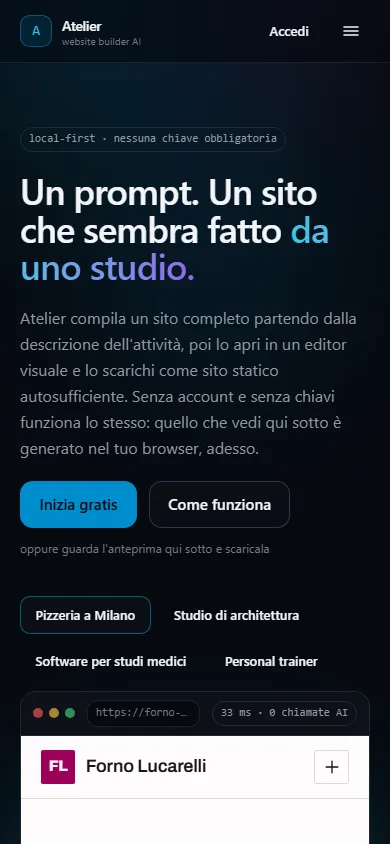
Opening a website for a business means deciding structure, copy, palette, legal pages and SEO. Someone who has never done it freezes at the first screen: templates help you decide where the logo goes; what the page should say is still a decision. I wanted the tool I needed at the beginning: a short description in, a complete site out, an editor to change it without touching code.
How I approached it
- Next.js and TypeScript: composer, editor and export live in one project, with no three codebases to keep in sync.
- A local composer that works without API keys: structure, pages and base copy come from rules, not from a model response that may never arrive.
- When an AI key exists, the model refines the copy; when it does not, the app says so instead of pretending.
- A self-contained static export: a folder of HTML and CSS that can be uploaded anywhere, without the builder backend.
- Legal pages generated as real pages, not as links that lead nowhere.
What changed
- Two months of work, from the first schema to an exported site.
- It works without API keys: the site is generated anyway.
- An export that opens on its own, with no dependency on the builder.
- Pages, palette, basic SEO and legal pages generated together, not left half done.
Limits and what is missing
It is almost finished: I am polishing the editor and the export, and some sections are better edited by hand. It is my project, which I use and let people try; there are no accounts to create. It does not promise a perfect site from one sentence, it promises a sensible base to correct.